English| EUR
Suggested for you
More currencies
Choose a language
The via ferrata to Trolltunga is not a gentler alternative to the classic hike—it is a technical alpine route that demands upper-body strength, nerve on exposure, and comfort with fixed steel. This guide breaks down the grading, conditions, and physical reality of Norway's most talked-about iron path.
Quick answer
The Trolltunga via ferrata is graded K3 (moderate to difficult) on the Norwegian scale, requiring sustained use of steel cables, iron rungs, and vertical ladders across exposed rock faces. The route demands previous via ferrata or climbing experience, fitness for five to seven hours of continuous movement, and comfort with significant vertical exposure above the fjord. Weather can close the route without notice, and retreat is difficult once committed.
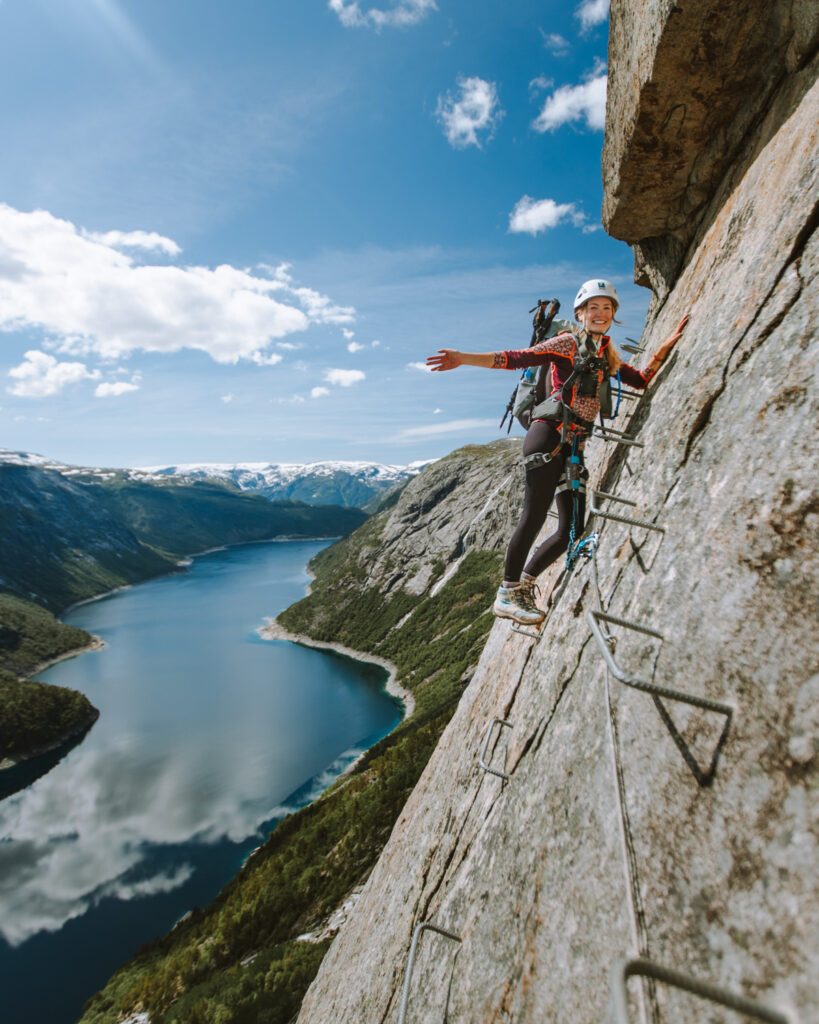
The via ferrata route to Trolltunga was installed to offer climbers a technical ascent through terrain the standard trail bypasses, not to simplify access. Graded K3 on Norway's via ferrata scale, the iron path sits in the moderate-to-difficult band—manageable for fit climbers with prior experience, punishing for those who underestimate its continuous exposure and stamina cost. The cable system spans roughly 1,200 meters of vertical rock, incorporating ladder sections, narrow traverses, and a final exposed ridge approach that leaves no room for hesitation. The route begins at the lower cable station near Mågelitopp and ascends steeply through a series of iron rungs bolted into the cliff face. Sections require pulling your full body weight on steel cables while your feet search for narrow footholds. The exposure is immediate and sustained—open air below you for much of the climb, with views across Ringedalsvatnet that demand focus rather than distraction. Weather determines difficulty more than fitness: rain transforms steel into slick, unforgiving surfaces, and cloud cover at altitude removes depth perception on the final approaches. The route remains accessible from late May through September, but operators cancel departures when conditions turn, and no refund compensates for misjudged timing. Physical demand is cumulative. Most underestimate the toll of gripping steel for hours, the forearm fatigue that arrives before the halfway point, and the leg burn from sustained ladder climbing. The descent follows a different cable section, so there is no psychological reprieve of retracing your steps—only continued engagement with the system. Previous via ferrata experience is not legally required but functionally non-negotiable; first-timers without climbing background often stall at exposure points, creating delays that cascade through guided groups. The trolltunga via ferrata difficulty is best understood as a multi-hour vertical puzzle that punishes inefficiency and rewards smooth movement through technical terrain. It is not a hike with cables added—it is a climb that happens to end at a famous rock formation. Approach it as such, or choose the trail.
“The via ferrata is not a hike with cables added—it is a climb that happens to end at a famous rock formation.”
This plan suits fit hikers ready for a demanding full-day ascent with technical via ferrata sections. Expect 10–12 hours round-trip from the Skjeggedal or Mågelitopp trailhead, including breaks.
Start at dawn to allow ample daylight for the 11 km ascent. Steady, moderate-grade hiking through forest and alpine terrain for the first 2–3 hours.
Reach the via ferrata staging area where steel cables, iron rungs, and fixed anchors begin. Clip into the safety line and transition to technical climbing with moderate exposure.
Navigate vertical rock faces and iron ladder sections requiring upper-body strength and confidence at height. The via ferrata reduces difficulty compared to unassisted scrambling but demands focus and stamina.
Reach the iconic rock outcrop 700 meters above Ringedalsvatnet. Rest, hydrate, and allow time for the platform if others are queuing.
Reverse the ascent, unclipping from via ferrata cables and retracing the trail. Knee strain increases on descent; trekking poles help on loose sections.
Complete the final forest descent as daylight wanes. Total elevation gain is approximately 900 meters each way.
Via ferrata routes demand specific safety equipment and preparation before you arrive at the trailhead.
The optimal window for the Trolltunga via ferrata is between July and August, when stable conditions and longer daylight hours mitigate the physical demands of the route. Arriving within the best arrival window of 00:00–08:00 is essential to avoid congestion and ensure sufficient time for the ascent.
Clear, 10°C to 18°C
The most stable period for climbing with reliable trail conditions.
Variable, 5°C to 15°C
Expect potential snow patches or early autumn rain which increase route difficulty.
—
Early starts ensure less time spent waiting at technical sections on the ferrata.
Verdict: The best time to undertake the via ferrata is on a weekday during July or August, arriving between 00:00 and 08:00 to manage safety and crowd levels effectively.
Access to the Trolltunga area itself is free, while participation in via ferrata activities requires professional guided services. Costs for these experiences are determined by external providers rather than public entry fees.
Verdict: Hikers pay 0 NOK for access to the trail, though paid parking and optional guided via ferrata services incur additional costs.
Trolltunga is accessible at all times, though visitors should plan their ascent to align with daylight hours and safety requirements.
Trolltunga is located at Skjeggedalsvegen, 5750 Odda, Norway. Access to the via ferrata starting point is primarily achieved by driving to the designated trailheads in Skjeggedal.
Rv13 to Odda, then follow signs to Skjeggedal
Shuttle bus from Odda to Skjeggedal
From P3 Skjeggedal parking to trailhead
The best arrival window is 00:00–08:00 to avoid crowds and secure limited parking. Parking fees apply at trailheads.
Everything you need to know about trolltunga via ferrata difficulty
The climb is considered a demanding mountain adventure that combines long-distance trekking with steep, exposed vertical sections. Because the route involves high-altitude exposure, the trolltunga via ferrata difficulty level requires participants to be in good physical condition and have strong endurance.
While professional guided tours often provide all necessary safety equipment and instructions, the trolltunga via ferrata difficulty is such that guides prioritize participants who are physically prepared for a full-day commitment. Previous climbing experience is generally not mandatory on these guided tours, though you must be comfortable with the physical exertion required.
Age requirements for the trolltunga via ferrata difficulty routes are typically strict, often requiring participants to be at least 15 years old for the full-day experience. Families should verify specific age minimums with tour providers before booking, as the physical demands are not suitable for small children.
The challenge stems from the combination of high exposure, wind, and the sheer length of the ascent, which contributes to the overall trolltunga via ferrata difficulty assessment. Even fit hikers may find the constant engagement of muscles during the climb to be significantly more taxing than a standard mountain walk.
While a standard hike to this landmark is graded as very demanding due to its 20–27 km length, the trolltunga via ferrata difficulty adds a technical vertical element. Both options require significant stamina, but the climbing route involves specialized equipment and a higher degree of mental concentration.
If you have a strong fear of heights, the trolltunga via ferrata difficulty will likely present a significant psychological challenge due to the steep, exposed faces above the fjord. Many operators explicitly state that these tours are not suitable for those with severe acrophobia.
The entire experience usually takes 10–12 hours to complete, covering both the approach and the climb itself. Given the intensity of the trolltunga via ferrata difficulty, it is standard practice to set aside an entire day for the excursion without planning other activities.
Trolltunga Via Ferrata Route Map & Topo
Read more GuideTrolltunga Via Ferrata Time & Completion Requirements
Read more GuideSafety and Risk: How Dangerous is the Via Ferrata?
Read more GuideDoing Trolltunga Via Ferrata Without a Guide
Read more Tickets & toursTrolltunga Via Ferrata Prices & Tour Booking
Read more